Friday, March 1, 2024

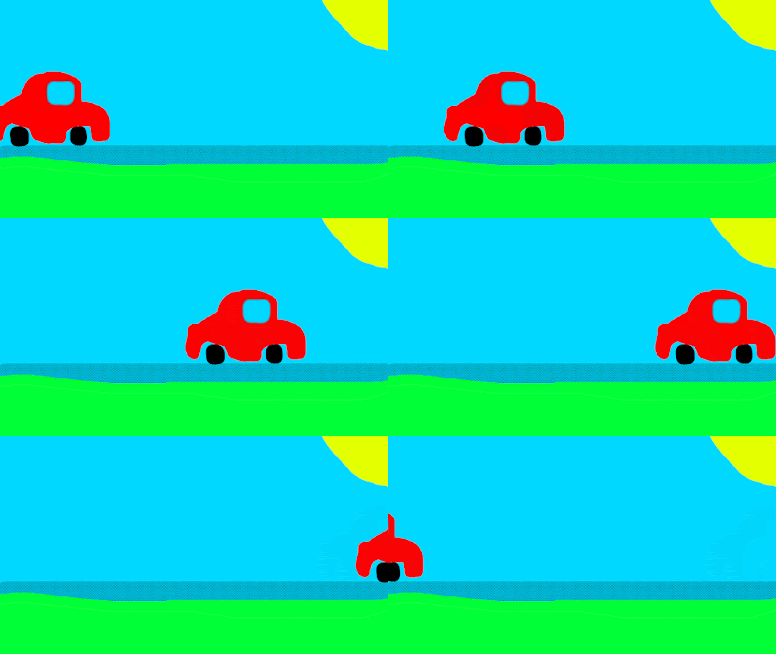
Line Animation


Alejandro
             
Alejandro


Star Trail Photography


Camera Settings Astrophotography

  https://www.adorama.com/alc/what-camera-settings-should-i-use-for-astrophotography/


What Camera Settings Should I Use for Astrophotography?


  1. Set Camera Dial to Manual Exposure Mode
  2. Adjust Exposure Compensation to Zero
  3. Go With a Very Wide Aperture
  4. Use Longer Shutter Speeds
  5. Set High ISO Levels
  6. Turn the Auto-Focus Feature OFF
  7. Select the Highest Resolution and Quality Setting
  8. Choose the RAW (or RAW + JPEG) Image File Format
  9. Set White Balance to Daylight
  10. Turn In-Camera Long Exposure Noise Reduction OFF
  11. Disable In-Camera Sharpening OFF
  12. Set Color Space to sRGB
  13. Turn Built-In Flash OFF
  14. Use a Remote Shutter Release
  15. Shoot in Bulb Mode
  16. Enable Mirror Lockup
  17. Cover the Viewfinder


Written by Adorama
|
Updated on May 6, 2022

LSST Astronomy- Large Synoptic Survey Telescope

 https://lsst.slac.stanford.edu/ 


When it takes up residency at the Vera Rubin Observatory in the high desert of Cerro Pachon, Chile, its job will be to capture the southern night sky, snapping an image every 15 seconds. The camera will capture 3,200 megapixels per shot and collect 15 terabytes of data per night over a 10 year period. It’s estimated there will be 10,000 scientific users for the data, including backyard telescope hobbyists.


Argus- DARPA


Weekly Vocabulary

   Zoopraxiscope-


The zoöpraxiscope (initially named zoographiscope and zoogyroscope) is an early device for displaying moving images and is considered an important predecessor of the movie projector. It was conceived by photographic pioneer Eadweard Muybridge in 1879 (and built for him by January 1880 to project his famous chronophotographic pictures in motion and thus prove that these were authentic). 

..it is the first apparatus ever used, or constructed, for synthetically demonstrating movements analytically photographed from life, and in its resulting effects is the prototype of all the various instruments which, under a variety of names, are used for a similar purpose at the present day.

— Eadweard Muybridge, Animals in Motion (1899)[4]

Kinetoscope-

The Kinetoscope is an early motion picture exhibition device. The Kinetoscope was designed for films to be viewed by one individual at a time through a peephole viewer window at the top of the device. The Kinetoscope was not a movie projector, but introduced the basic approach that would become the standard for all cinematic projection before the advent of video, by creating the illusion of movement by conveying a strip of perforated film bearing sequential images over a light source with a high-speed shutter. 


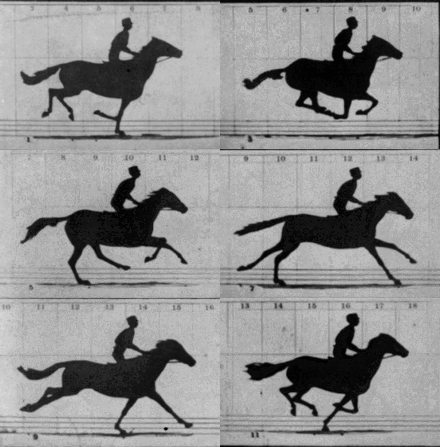
Chronophotography-Chronophotography is a photographic technique from the Victorian era which captures a number of phases of movements. The best known chronophotography works were mostly intended for the scientific study of locomotion, to discover practical information for animal handlers and/or as reference material for artists. Although many results were not intended to be exhibited as moving pictures, there is much overlap with the more or less simultaneous quest to register and exhibit photographic motion pictures.


Artist of the Week Eadweard Muybridge


http://www.tate.org.uk/whats-on/tate-britain/exhibition/eadweard-muybridge


http://www.tate.org.uk/whats-on/tate-britain/exhibition/eadweard-muybridge


Eadweard Muybridge
Leland Stanford, Jr. on his Pony "Gypsy"—Phases of a Stride by a Pony While Cantering 1879
http://www.moma.org/collection/artists/4192

https://alumni.stanford.edu/get/page/magazine/article/?article_id=39117

LIGHTS, CAMERA, ACTION: Muybridge's famous 1878 photo sequence depicts three full strides made by Stanford's prize trotting horse, Abe Edgington. Around the middle of each stride, all four feet lift at once--as shown, for instance, in the next-to-last frame. 

         1. How is the technical quality? 

         2. How’s the composition?

         3. What do you find interesting  about his work?


Water Droplets